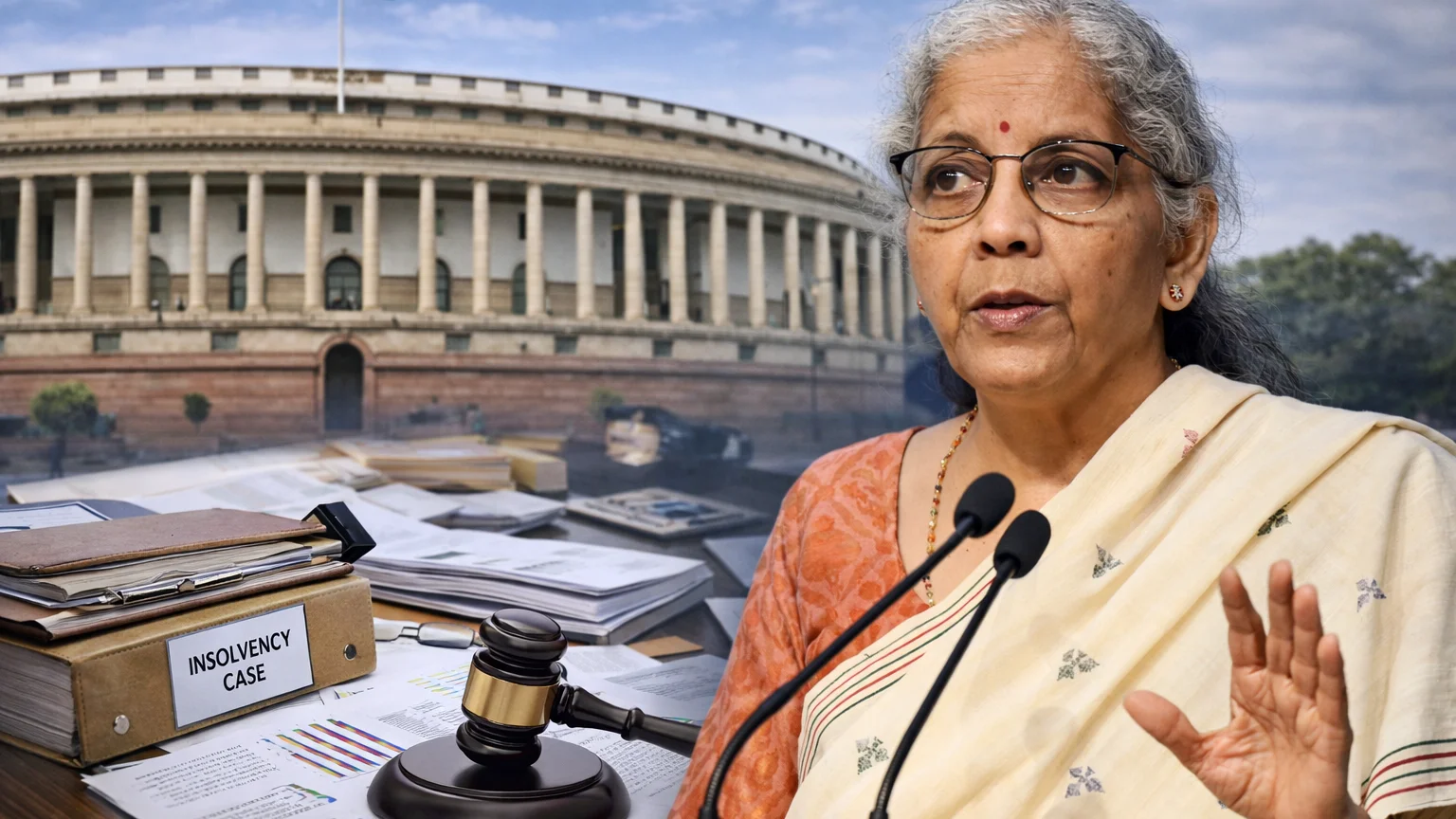
NEW DELHI, March 30: The Lok Sabha has passed the Insolvency and Bankruptcy Code (Amendment) Bill, in a move the government says is aimed at fixing some of the biggest delays and legal grey areas that have slowed India’s insolvency system in recent years. The Bill updates the Insolvency and Bankruptcy Code, 2016, a law originally designed to provide a time-bound process for rescuing or closing distressed companies.
Finance Minister Nirmala Sitharaman, while defending the Bill in the House, said the amendments are meant to address procedural delays and “interpretational issues” that have emerged through litigation and stakeholder disputes. The Bill had first been introduced in the Lok Sabha in August 2025, then referred to a Select Committee before returning for passage during the Budget Session.
The reason these changes matter is simple: the IBC was supposed to be India’s answer to endless debt recovery battles, but over time, the process itself has become slow and heavily litigated. Under the law, corporate insolvency cases were meant to move within 180 days, extendable to 270 days, and later capped at 330 days including litigation. But in reality, many cases have taken far longer. According to PRS, insolvency cases that ended in an approved resolution plan took an average of 602 days to conclude as of June 30, 2025 — almost double the intended ceiling.
The Numbers Show Why the Government Felt Pressure to Act
The data behind India’s insolvency system explains why this amendment Bill is not just technical housekeeping. As of June 2025, a total of 8,492 corporate insolvency resolution process (CIRP) cases had been admitted under the IBC, according to PRS using IBBI data. Out of those, 1,905 cases were still ongoing, while the rest had already been closed through resolution, liquidation, withdrawal, settlement or appeal.
But the bigger concern is how those cases ended. Of 6,587 closed CIRP cases, only 1,258 cases (19%) ended with an approved resolution plan, while 2,824 cases (43%) ended in liquidation. Another 1,191 cases (18%) were withdrawn, and 1,314 (20%) were closed through appeal, review or settlement. That means liquidation has remained a larger outcome than rescue in a significant share of closed cases — one of the biggest criticisms of how the system has functioned in practice.
There is also a backlog problem. PRS noted that around 78% of ongoing CIRP cases had already continued for more than 270 days, underlining how the “time-bound” structure of the law has repeatedly run into delays at the tribunal and litigation stage. Separately, PRS cited that as of December 2024, 20,484 cases were pending before the National Company Law Tribunal (NCLT), including 12,351 IBC cases.
What the Amendment Bill Actually Tries to Fix
One of the most closely watched changes is the attempt to reinforce faster admission timelines. Reporting around the Bill has highlighted the government’s push to make sure insolvency applications do not remain stuck at the entry stage once a clear default is established. That matters because some of the biggest value erosion in distressed companies begins before the resolution process even properly starts.
The Bill also introduces a Creditor-Initiated Insolvency Resolution Process (CIIRP) — a new out-of-court commencement route for select notified financial creditors. In simple terms, this is meant to create a more structured alternative to the traditional insolvency path, especially in cases where lenders want quicker control and resolution before value deteriorates further. PRS has described this as one of the Bill’s major structural changes.
Another notable shift is in liquidation. The Bill removes some powers from the liquidator relating to claim admission, rejection and valuation, while giving the Committee of Creditors (CoC) a stronger role in appointing or removing the liquidator and supervising liquidation. It also clarifies that statutory dues do not automatically get the status of secured creditors, which is important because disputes over claim priority have often complicated recovery battles.
The legislation also opens the door to cross-border insolvency rules, though PRS has flagged that the Bill largely empowers the central government to frame the rules later rather than setting out a full statutory framework inside the Bill itself. That means one part of the reform remains unfinished and will likely need close scrutiny once the rule-making process begins.
Why Banks, Homebuyers, MSMEs and Stalled Projects Are Watching Closely
This is not just a law for lawyers and lenders. IBC delays have had direct consequences for banks, homebuyers, developers, suppliers, MSMEs and even salaried employees linked to stressed companies. When cases remain stuck for too long, asset values erode, projects remain incomplete, and recovery for all stakeholders usually worsens.
That is especially visible in real estate-linked insolvency. In a Rajya Sabha reply last year, the Finance Minister said 1,522 insolvency cases had been admitted in the real estate and construction sector up to March 2025, while only 204 cases had been resolved. At the same time, average recovery in resolved realty cases stood at 44.7% of admitted claims, though realisation was much higher relative to liquidation value. That explains why homebuyers and lenders both have a direct stake in whether insolvency reforms actually speed up stalled project resolution.
For banks, the logic is straightforward: the longer a bad asset remains trapped in legal and procedural delay, the lower the eventual recovery often becomes. PRS noted that resolved cases under IBC had yielded recoveries of around 33% of admitted claims and 171% of liquidation value as of June 2025. That suggests the law can preserve value — but only when it works in time.
For MSMEs and operational creditors, the issue is often even more immediate. Smaller firms are usually the first to feel the pain when a larger debtor remains stuck in limbo. Faster admission and more predictable resolution may not solve every structural problem, but they can at least reduce the chain damage that delayed insolvency often causes across suppliers and service providers.
The Real Test Starts After Parliament, Not Inside It
That is the most important point in this story. The Bill’s passage is politically and economically significant, but it does not automatically mean the insolvency system will suddenly become fast and efficient. The real test will be whether these amendments reduce litigation, improve NCLT functioning, cut admission delays and increase the share of companies that are actually resolved rather than liquidated.
In other words, the government has now moved to repair a law that was once sold as one of India’s most important structural economic reforms. The amendments show there is recognition in New Delhi that the system needed fixing. The harder question — and the one banks, borrowers, homebuyers and businesses will now watch — is whether the repair works in practice.
For now, the IBC has entered its next phase: not a debate over whether India needs a bankruptcy code, but whether the country can finally make it run at the speed it was originally promised.