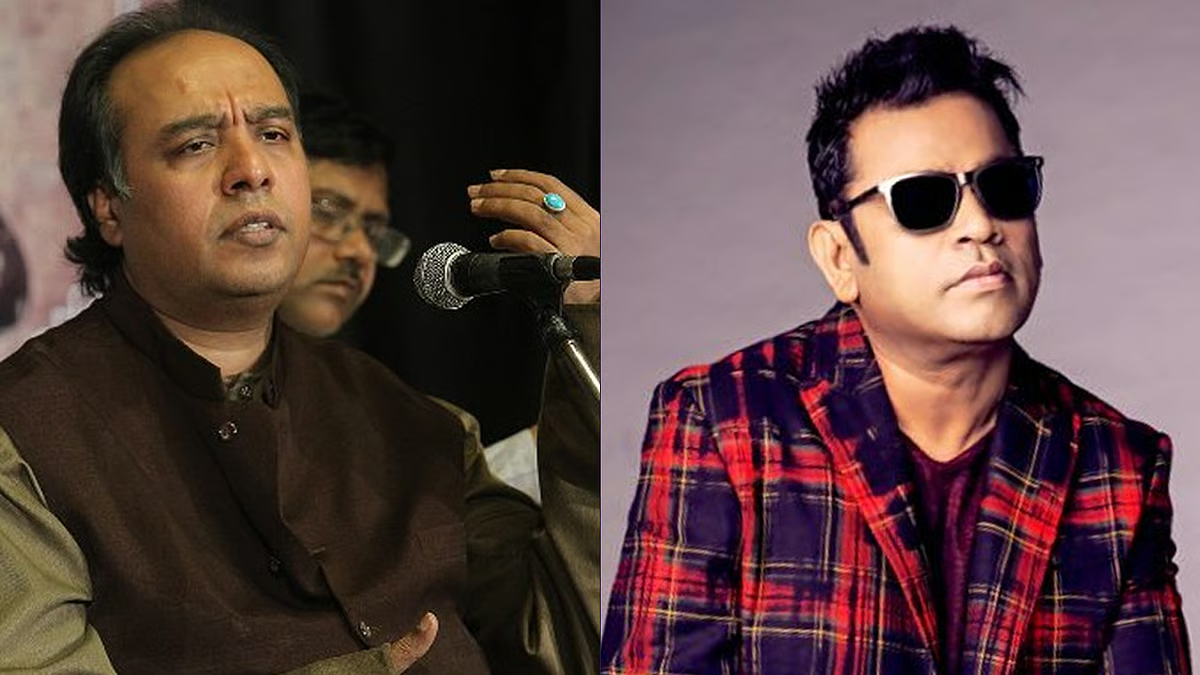
New Delhi | In a significant move that bridges the gap between modern cinema and traditional classical heritage, Oscar-winning music composer A.R. Rahman has agreed to formally acknowledge the contribution of the Junior Dagar brothers in the hit track Veera Raja Veera from the Tamil blockbuster Ponniyin Selvan II.
The agreement was recorded on Friday before a Supreme Court bench comprising Chief Justice of India Surya Kant, Justice Joymalya Bagchi, and Justice Vipul M. Pancholi. Representing Rahman, Senior Advocate Abhishek Manu Singhvi informed the court that his client consented to modifying the song’s credits across all OTT and digital platforms within the next five weeks.
The newly mandated credit line will read: “Composition inspired from the Dagarwani tradition Dhrupad, first recorded as ‘Shiv Stuti’ by late Ustad Nasir Faiyazuddin Dagar and Ustad Nasir Zahiruddin Dagar, popularly known as Junior Dagar brothers.”
The Roots of the Dispute The legal battle originated shortly after the theatrical release of Ponniyin Selvan II (PS-2) directed by Mani Ratnam. Ustad Faiyaz Wasifuddin Dagar, a Padma Shri awardee and the successor of the Dagar lineage, filed a copyright infringement suit in the Delhi High Court. He alleged that the musical structure, rhythm, and core melody of Veera Raja Veera were identical to Shiva Stuti, a 1970s classical composition famously recorded by his father and uncle (the Junior Dagar Brothers) in Amsterdam in 1978.
While Rahman’s defense maintained that Shiva Stuti was a traditional piece residing in the public domain and that Veera Raja Veera was a uniquely layered, modern orchestration, the Dagar family insisted that the soul of their specific composition had been lifted without consent or proper attribution.
The Legal Seesaw The case has seen its fair share of dramatic legal twists. In April 2025, a single-judge bench of the Delhi High Court found a prima facie case of copyright infringement. The court ordered Rahman and production house Madras Talkies to amend the credits, pay ₹2 lakh in litigation costs, and deposit a hefty ₹2 crore with the court registry as security.
However, a Division Bench of the High Court later overturned this interim order in September 2025, ruling that proving exclusive authorship of a traditional Dhrupad piece required a full trial. This prompted Ustad Dagar to approach the Supreme Court.
Respect Over Royalties The breakthrough came during a hearing on February 13, 2026, when the Supreme Court subtly nudged the filmmakers and Rahman to look beyond strict legal technicalities. Noting the immense contribution of traditional musical gharanas, the bench remarked, “They are traditional worshippers of classical music. He is not in the competitive domain. They want respect and recognition.”
By agreeing to the credit update, Rahman has put the immediate attribution controversy to rest. However, the Supreme Court clarified that this is an interim arrangement and the main copyright infringement suit will continue independently in the Delhi High Court, uninfluenced by Friday’s developments. The ₹2 crore previously deposited by Rahman will remain with the High Court registry pending the final verdict.