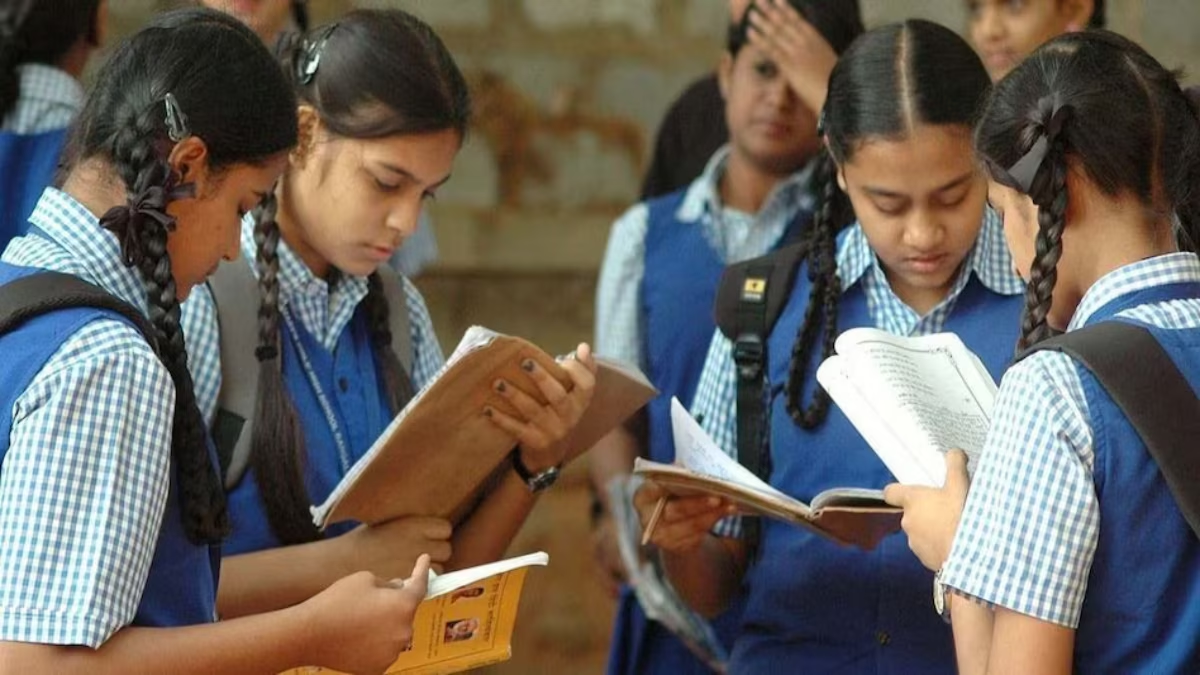
New Delhi: The Central Board of Secondary Education (CBSE) conducted the Class 12 Chemistry examination this week, with many students and teachers describing the paper as closely aligned with the NCERT syllabus but requiring thorough conceptual preparation. Education experts noted that while the questions were drawn from prescribed textbooks, the examination tested in-depth understanding rather than superficial learning.
According to educators who reviewed the question paper, most sections reflected the official CBSE blueprint and syllabus for the 2025–26 academic session. However, several questions demanded clarity of fundamental concepts and application-based reasoning. “The paper was largely NCERT-focused, but students who relied only on selective preparation may have found some parts challenging,” said an experienced Chemistry educator who analysed the exam shortly after it concluded.
Students emerging from examination centres across Delhi and other cities described the paper as moderate in difficulty. Many reported that numerical problems and case-based questions required careful reading and step-by-step reasoning. Organic Chemistry and Electrochemistry were among the sections that reportedly required deeper conceptual command, while Inorganic Chemistry questions were seen as more direct and textbook-based.
Teachers said the structure of the paper followed the pattern announced by CBSE earlier in the year. The examination included multiple-choice questions, short-answer questions, and long-answer sections designed to assess analytical thinking. “There were no unexpected topics outside the syllabus, but the framing of certain questions tested conceptual clarity,” another teacher explained, adding that students who practiced previous years’ papers and exemplar problems were better prepared.
CBSE had earlier issued detailed guidelines outlining the distribution of marks and typology of questions for the Chemistry paper. The board has consistently emphasised competency-based assessment, aiming to evaluate understanding rather than rote memorisation. In recent years, the proportion of application-based and case-study questions has gradually increased, reflecting broader reforms in secondary education assessment.
Students said time management played a key role during the three-hour examination. “The paper was lengthy but manageable if one had prepared well,” said a student outside an examination centre in central Delhi. Others noted that while direct questions were present, some required connecting concepts across chapters, particularly in Physical Chemistry.
The Chemistry examination is considered significant for students pursuing science streams, especially those planning careers in engineering, medicine, and pure sciences. Performance in the subject often influences overall board results and eligibility for competitive entrance examinations. With the exam now completed, attention will turn to upcoming papers and eventual result announcements, which are typically declared in May.
Education experts believe the exam pattern reinforces the importance of systematic preparation. “Students should not limit themselves to selective study. Comprehensive reading of NCERT and consistent practice are essential,” an educator said, pointing out that board examinations increasingly reward conceptual clarity over memorised responses.
The Class 12 board examinations began earlier this month and are being conducted across examination centres in India and abroad. CBSE has implemented standard examination protocols, including strict invigilation procedures and adherence to syllabus guidelines.
As students await results, educators advise reviewing performance realistically and focusing on forthcoming competitive exams. The feedback from this year’s Chemistry paper suggests that a structured approach aligned with the syllabus remains the most reliable strategy for success.