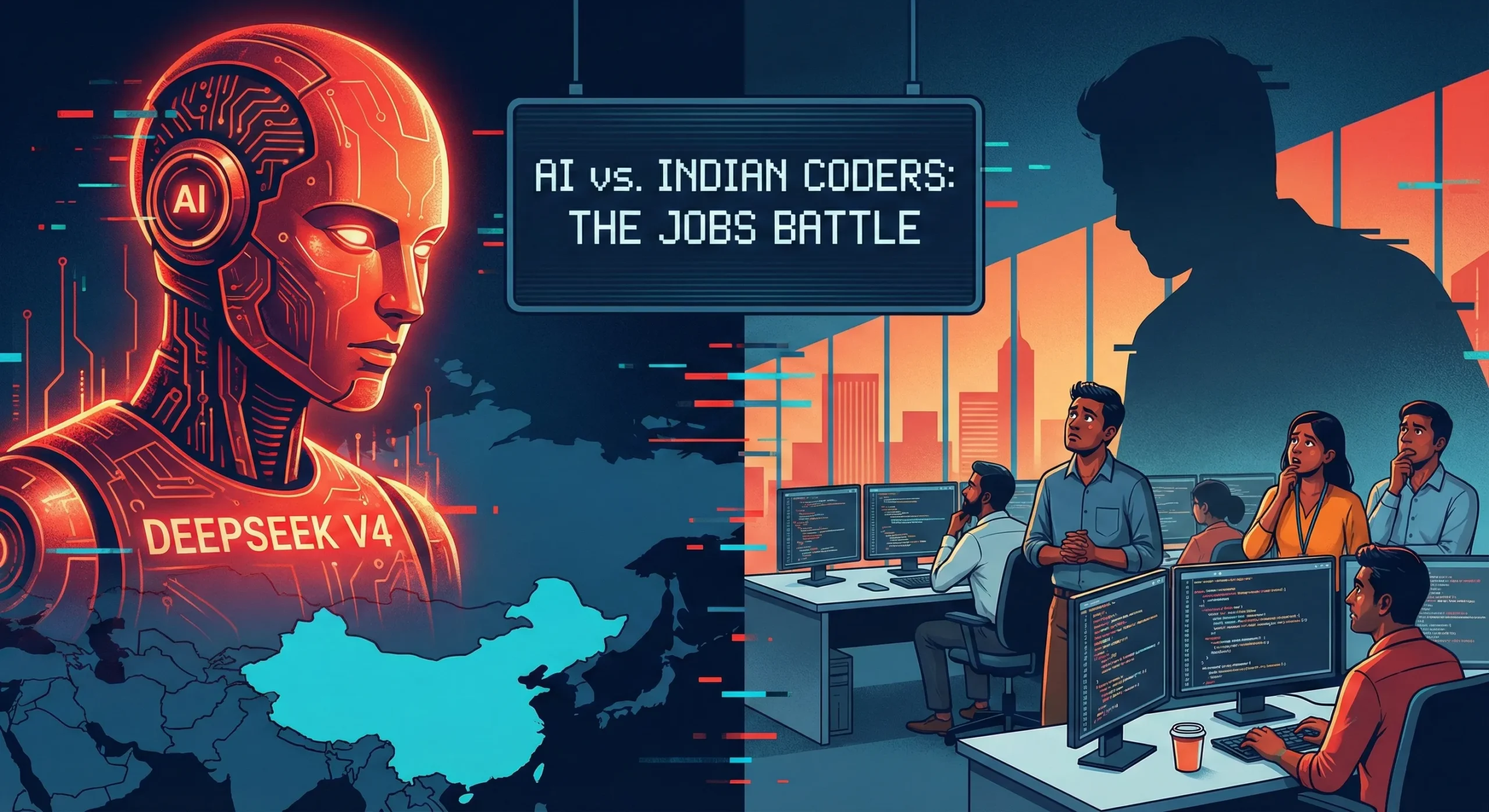
For three decades, the math was simple: If a developer in San Francisco costs $100 an hour, a developer in Bengaluru costs $20. That margin built the empires of TCS, Infosys, and Wipro. But next week, that math might fundamentally break.
With the imminent launch of DeepSeek V4, the “cost arbitrage” model is facing its deadliest challenger yet. Early leaks suggest that the Chinese model isn’t just good at coding—it is elite. It can reportedly refactor legacy codebases, debug complex Python scripts, and write full-stack React applications with higher accuracy than a human junior developer.
The “Penny Coder” Problem The threat isn’t that AI is smarter; it’s that AI is cheaper. “Why would a US bank hire a team of 50 freshers in Pune to maintain their Java backend when DeepSeek V4 can do it for $500 a month?” asks a senior analyst at Gartner. “We are moving from ‘Offshoring’ to ‘AI-shoring.’ The geography doesn’t matter anymore; the compute does.”
Panic in the Cubicles On the ground in Electronic City and Hitec City, the mood is tense. Recruitment for entry-level roles (the infamous “mass hiring”) has already slowed to a crawl in 2025. With V4, fears are mounting that the “bench”—where thousands of unassigned engineers sit—will be permanently cleared out. “I used to check my juniors’ code,” says a Tech Lead at a major service firm in Bengaluru. “Now, I just feed their tasks to the AI. It’s faster, it doesn’t complain, and it doesn’t take sick leave. DeepSeek V4 is just going to make that official.”
The Upskilling Myth While industry titans preach “upskilling” and “AI-first workflows,” the reality is harsher. The ladder has lost its bottom rungs. If AI does the junior work, how does a fresher become a senior? India produces 1.5 million engineers a year. If DeepSeek V4 can replace the bottom 40% of that workforce, the social and economic fallout could be catastrophic. The “demographic dividend” is at risk of becoming a “demographic burden.”