For the last two years, the AI narrative has been dominated by one metric: speed. But with the release of Gemini 3 Deep Think this week, Google has officially shifted the goalposts to depth.
In a move that has sent shockwaves through Silicon Valley, Google unveiled its latest “reasoning” model, designed specifically for complex science, mathematics, and engineering tasks. Unlike standard chatbots that predict the next word, Deep Think is architected to pause, evaluate multiple “thought trajectories,” and self-correct before responding—a process similar to OpenAI’s o1 but, according to benchmarks, significantly more potent.
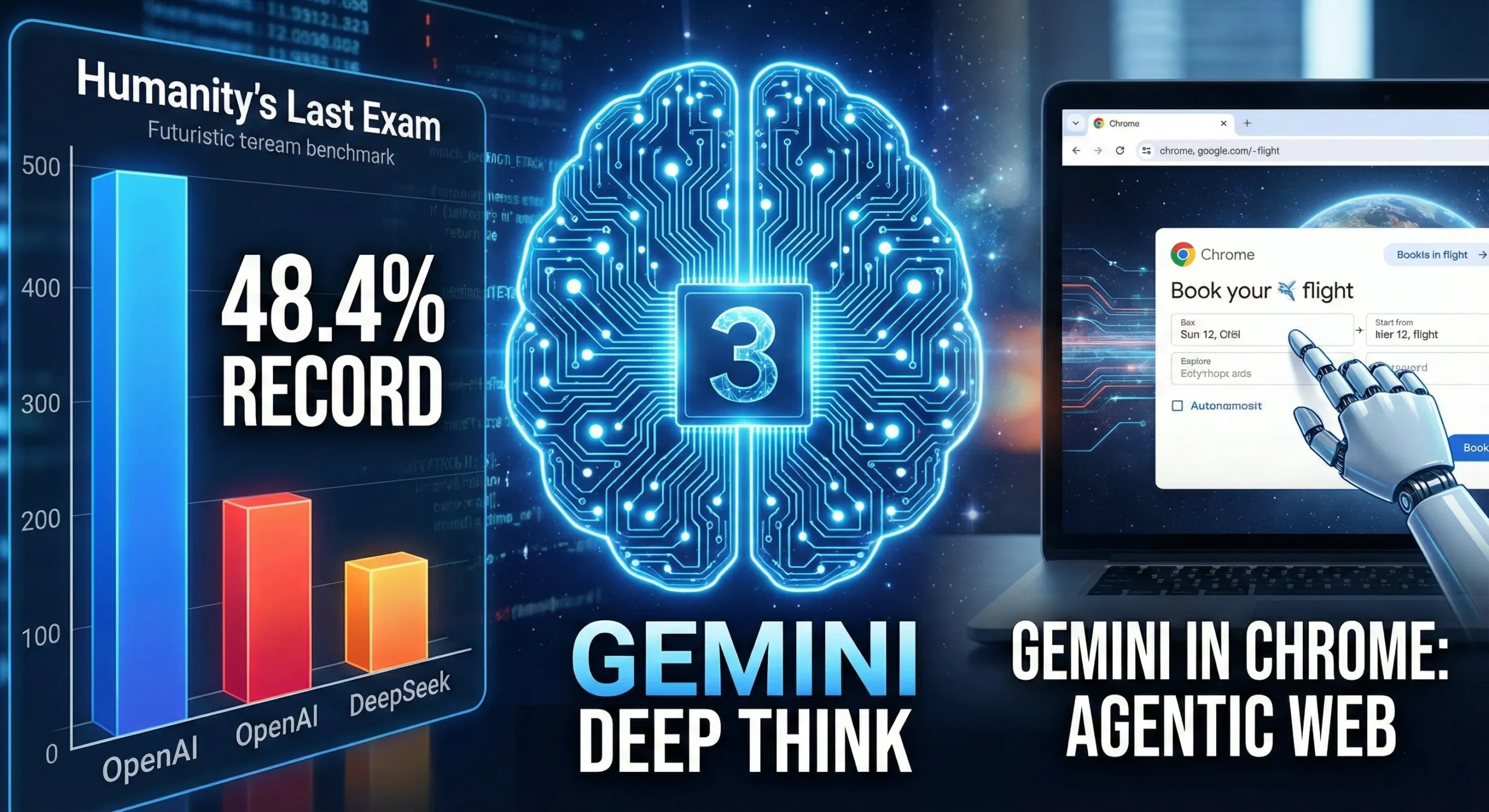
The “Humanity’s Last Exam” Shock The headline number everyone is talking about is 48.4%. This is the score Gemini 3 Deep Think achieved on “Humanity’s Last Exam,” a benchmark notoriously designed to be impossible for AI, featuring questions from the edges of modern physics and abstract mathematics.
To put this in perspective:
- OpenAI’s o3 (Deep Research): Scored 26.6%
- DeepSeek R1: Scored a measly 9.4%
- Gemini 3 Deep Think: 48.4% (without external tools)
“This isn’t an incremental update,” said a Google DeepMind researcher on X. “We are seeing the model solve problems that usually require a team of human researchers days to crack. It’s reached Gold Medal standards in the International Math and Physics Olympiads.”
Gemini in Chrome: The Agent Arrives While Deep Think conquers the lab, Google is also aggressively deploying agents to your browser. The update introduces “Gemini in Chrome,” an autonomous feature rolling out to AI Ultra subscribers in the US.
This is no longer a sidebar chatbot. You can now give Chrome a high-level command like, “Find a hotel in Chicago under $200 that has a gym, check for availability next weekend, and put the options in a spreadsheet.” The browser then takes over—opening tabs, clicking buttons, reading cancellation policies, and compiling the data while you watch. It is the first mainstream realization of the “Agentic Web.”
Coding at a “Grandmaster” Level For developers, the news is even bigger. On Codeforces, a competitive programming platform, Gemini 3 Deep Think has achieved an Elo rating of 3455, placing it in the “Legendary Grandmaster” tier. This makes it statistically better at algorithmic coding than 99.9% of human programmers.
The Strategic Shift Google’s strategy is clear: Let OpenAI and Meta fight over social media bots and video generation. Google wants to own the “Intelligence Layer” of the economy—the scientists, the engineers, and the coders. By integrating this power directly into Chrome and the Gemini API, they are building a moat that might be impossible to cross.