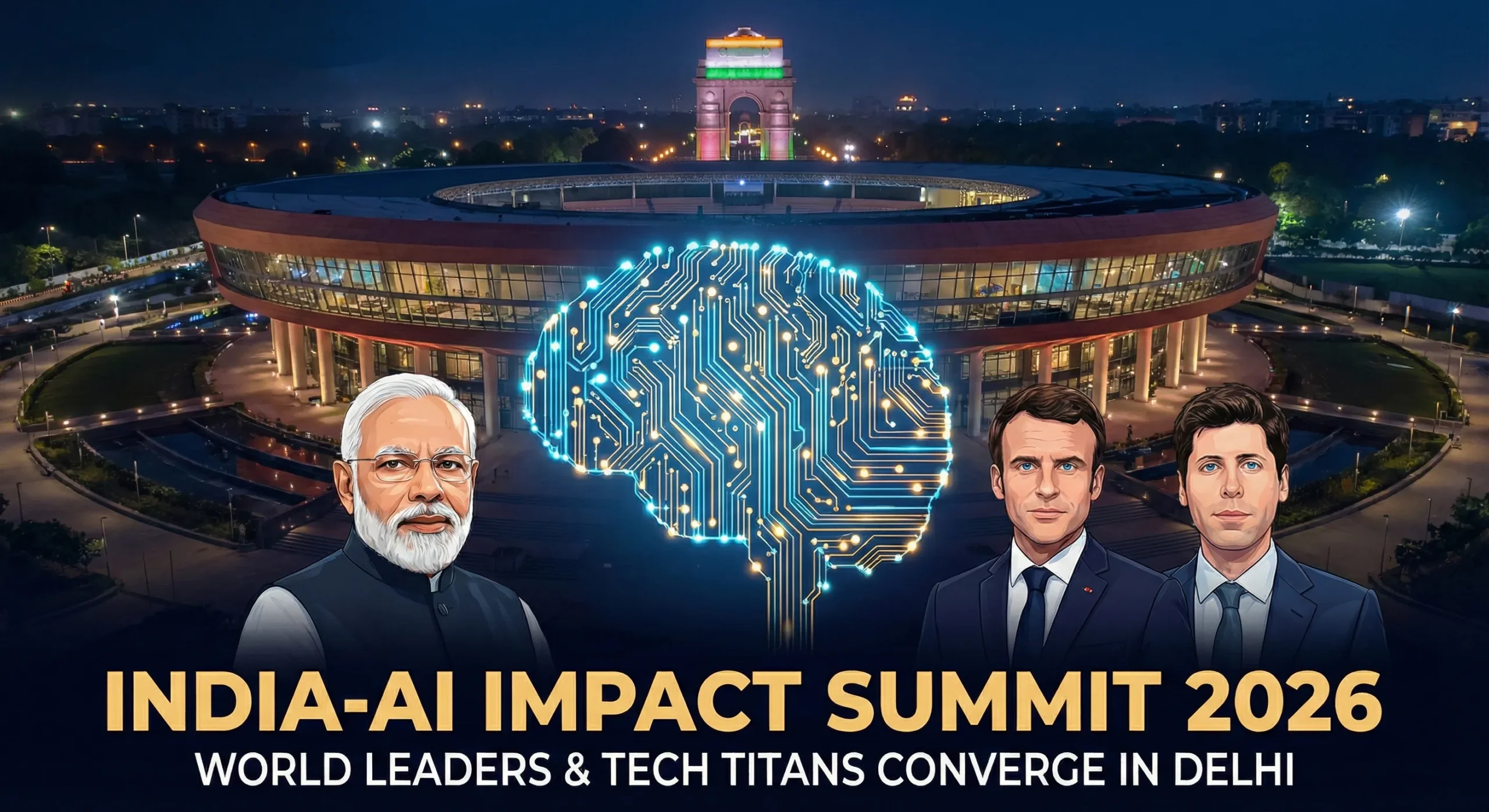
The flags are up, the security perimeters are set, and the Bharat Mandapam is once again the center of the world. Two years after hosting the G20, New Delhi is set to host a different kind of power gathering: the India-AI Impact Summit 2026.
Starting Monday, February 16, this summit represents Prime Minister Narendra Modi’s most ambitious tech-diplomacy gamble yet. The goal? To move India from being the world’s “back office” to its “AI control room.”
The Guest List: Politics Meets Silicon Valley The tarmac at Indira Gandhi International Airport will be busy. French President Emmanuel Macron is arriving Sunday evening to co-inaugurate the “Year of Innovation” with PM Modi—a bilateral pact expected to unlock billions in sovereign AI computing credits. Joining them is UAE Crown Prince Sheikh Khaled, who is reportedly looking to align the UAE’s “Falcon” AI models with India’s vast data infrastructure.
But the real frenzy is around the tech CEOs. Sam Altman (OpenAI) and Sundar Pichai (Google) are confirmed attendees. Sources suggest both are vying for exclusive access to the Indian government’s new “Bhashini” voice dataset—the largest multilingual repository in human history.
The “Missing Man” Mystery However, the biggest headline might be who isn’t coming. Jensen Huang, CEO of NVIDIA, has reportedly pulled out of the summit at the last minute. His absence is fueling intense speculation. Rumors in the corridors of the Ministry of Electronics and IT (MeitY) suggest a deadlock over the “Sovereign GPU Cloud” deal. Is India pivoting away from Nvidia to build its own custom silicon, possibly with help from a French or American consortium? The silence from Nvidia’s camp is deafening.
The Agenda: The Global South’s Turn While the West worries about “AGI safety,” India’s agenda is grounded in reality. The summit’s theme, “AI for All: Health, Agriculture, and Language,” signals India’s intent to lead the deployment of AI in the Global South. “We are not here to discuss sci-fi scenarios,” said a senior official from the Prime Minister’s Office. “We are here to discuss how AI can detect cancer in a village in Bihar or teach math to a child in Kenya using a $50 smartphone.”
As the delegates arrive, the message is clear: The next phase of AI won’t just be defined by who builds the smartest model, but by who gets it into the hands of the next billion users. And for that, all roads lead to Delhi.