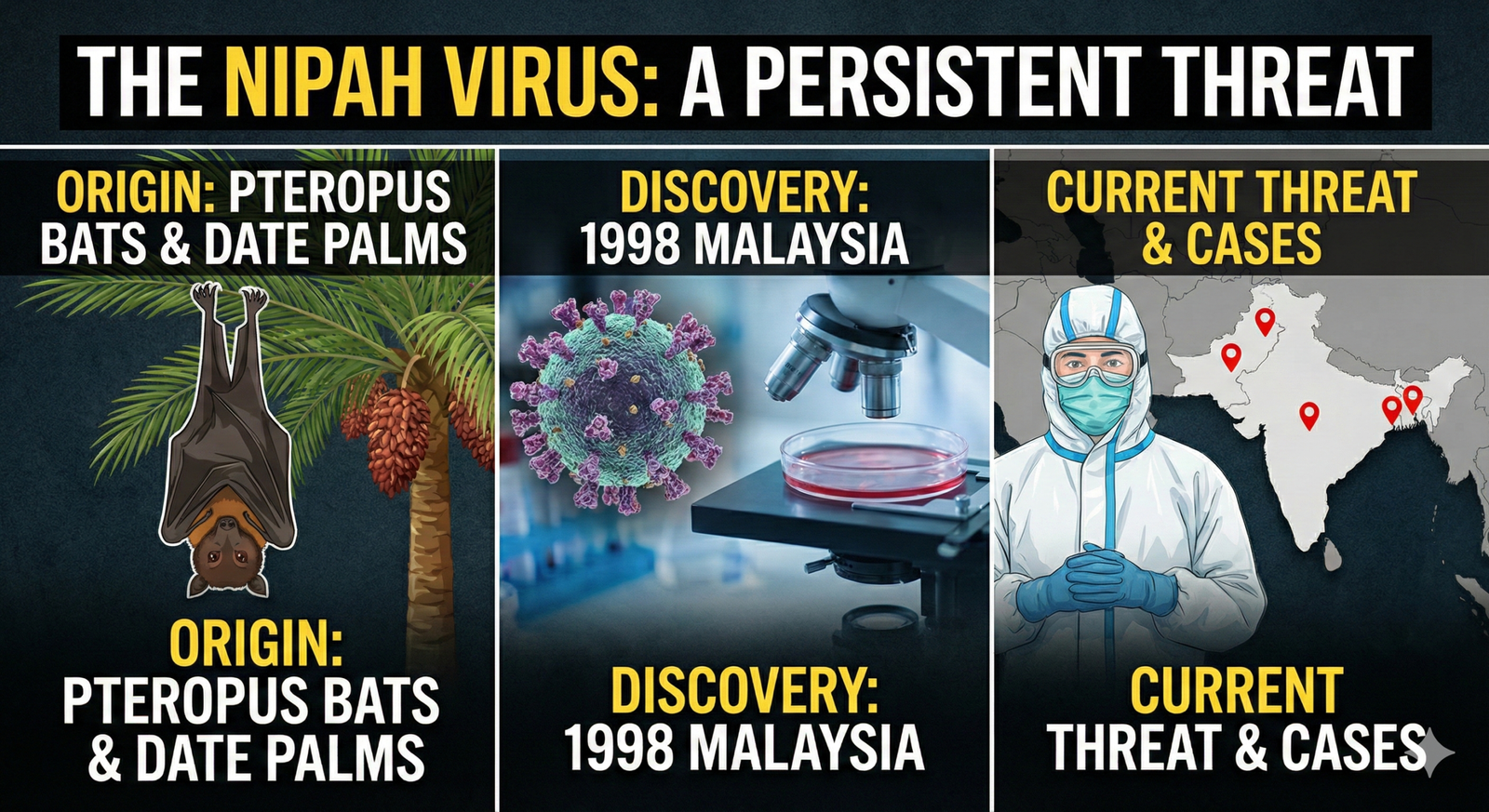
New Delhi/Kuala Lumpur: In the crowded gallery of dangerous infectious diseases, the Nipah virus (NiV) has a small but deeply unsettling presence. It doesn’t spread as explosively as COVID-19, yet when it infects, it often kills. With a case fatality rate estimated between 40% and 75%, the World Health Organization (WHO) has placed Nipah on its list of “priority pathogens” that could trigger the next major health emergency.
But how did a virus quietly tucked away in the wild find its way into human lives? And why does it keep resurfacing? The story of Nipah is as much about our changing relationship with nature as it is about a deadly pathogen.
The Discovery: A Mystery Illness in Sungai Nipah (1998)
Nipah’s story does not begin in a high-security lab but on pig farms in Malaysia.
In September 1998, pig farmers in the village of Kampung Sungai Nipah started falling ill with a strange, rapidly worsening disease. At first, doctors suspected Japanese Encephalitis (JE), a mosquito-borne infection already familiar in the region. Fogging operations were launched, pesticides were sprayed, and mosquitoes were blamed.
But the deaths continued.
Patients were not just running high fevers. Many were developing severe inflammation of the brain—encephalitis—slipping into confusion, seizures and, in too many cases, coma and death. The usual explanation no longer fit.
It was at this point that Dr. Chua Kaw Bing, a virologist at the University of Malaya, chose to challenge the prevailing view. While much of the health establishment remained focused on JE, he suspected something else was at work. Examining brain tissue from a victim, he isolated a previously unknown virus.
In March 1999, the US Centers for Disease Control and Prevention (CDC) confirmed his suspicion: this was a novel paramyxovirus, never before seen in humans. It was named “Nipah” after Kampung Sungai Nipah, the village where it was first identified.
By the time the outbreak was brought under control, it had already spread to Singapore. The toll was severe: around 265 reported cases and 105 deaths. To stop the virus in its tracks, the Malaysian government ordered the culling of more than 1 million pigs—a brutal but necessary measure that devastated the local pork industry and livelihoods.
The Origin: Tracing the Virus Back to Flying Foxes
Once the virus had a name, another question emerged: where had it been hiding?
Researchers eventually traced Nipah back to fruit bats of the genus Pteropus, commonly known as “flying foxes.” These large bats carry the virus without falling sick themselves, making them its natural reservoir.
The likely chain of events in the 1998 outbreak looked like this:
- Deforestation and habitat loss pushed fruit bats closer to farms and human settlements.
- Bats fed on fruit trees near pig farms, dropping half-eaten fruit or urine into pig enclosures.
- Pigs consumed the contaminated fruit and became “amplifying hosts,” allowing the virus to multiply efficiently.
- Farmers and workers who handled the infected pigs then contracted the virus.
In other words, human interference with natural ecosystems helped bridge the gap between wild bats and domesticated animals—and finally, humans.
The Shift: From Animal Spillover to Human Transmission (India & Bangladesh)
The Malaysian outbreak was largely driven by pigs. But as Nipah reappeared in South Asia, its pattern shifted in alarming ways.
In 2001, outbreaks were reported in Siliguri, West Bengal (India), and Meherpur, Bangladesh. This time, there were no pig farms at the centre of the story.
In Bangladesh and parts of India, fresh date palm sap is a popular winter delicacy. The sap is collected overnight in open pots attached to trees—a perfect invitation for fruit bats. Attracted by the sweetness, bats lick the sap or urinate into the containers. The next morning, humans drink it raw, often without boiling.
This provided Nipah with a new route: directly from bats to humans via contaminated food.
The outbreaks in India and Bangladesh also revealed something more troubling:
- No pigs required: The virus no longer needed an intermediate animal host.
- Human-to-human transmission: There was clear evidence of Nipah spreading within families and in hospitals—from patients to relatives, and from patients to healthcare workers.
Nipah was no longer just a virus of bats and pigs. It had begun to exploit human networks of care and community.
Major Outbreaks: A Timeline of Recurring Threat
Since 1998, Nipah has surfaced again and again, particularly in Bangladesh and India. Some of the major episodes include:
- 1998–1999 (Malaysia/Singapore): The inaugural outbreak. Around 276 cases and 106 deaths. The large-scale culling of pigs eventually contained the spread.
- 2001 (Siliguri, India): 66 cases, 45 deaths. This outbreak provided the first strong evidence of person-to-person transmission in a hospital setting.
- 2001–Present (Bangladesh): Bangladesh has reported Nipah outbreaks almost every winter, coinciding with the date palm sap season. The country has recorded more than 340 cases so far, with a fatality rate exceeding 70%.
- 2007 (Nadia, West Bengal): 5 cases, 5 deaths—a 100% mortality rate that sent shockwaves through local health systems.
- 2018 (Kerala, India): A scare in Kozhikode that captured national attention. There were 18 confirmed cases and 17 deaths. The Kerala government’s quick response, aggressive contact tracing and isolation measures are widely credited with averting a much larger disaster.
- 2019, 2021, 2023 (Kerala, India): Sporadic cases have continued to emerge, often during the monsoon months, keeping health authorities on permanent alert.
Each outbreak has been relatively small in numbers. Yet each has reinforced the same message: Nipah is not going away.
Why Nipah Virus Is So Dangerous
Compared to COVID-19, Nipah is less contagious; it does not typically spread over long distances through the air. But three factors make it a nightmare scenario for epidemiologists:
- High Mortality: While COVID-19’s overall death rate has generally remained below 2%, Nipah’s fatality rate ranges from 40% to 75% depending on the outbreak and the quality of care. In some clusters, almost everyone infected has died.
- No Specific Treatment or Vaccine (as of 2026): There is currently no approved antiviral drug or vaccine for Nipah in humans. Treatment is largely supportive—keeping patients hydrated, managing fever and seizures, and providing intensive care when possible. For many patients, especially in resource-limited settings, that is not enough.
- Long-Term Effects: Survival does not always mean safety. Some patients develop relapsing encephalitis—brain inflammation that can return months or even years after apparent recovery. These delayed complications can be disabling or fatal.
This combination of high lethality, lack of targeted treatment, and the possibility of human-to-human spread is what keeps Nipah on the radar of global health agencies.
The Current Situation: A Local Virus With Global Implications
Today, Nipah is widely recognised as a recurring threat in South and Southeast Asia, particularly in Bangladesh and parts of India. But in a world as interconnected as ours, a virus does not need a passport to travel.
Indian agencies like the Indian Council of Medical Research (ICMR), along with global organisations such as the Coalition for Epidemic Preparedness Innovations (CEPI), are supporting research into Nipah vaccines and treatments. Early-stage trials are under way, offering cautious hope that future outbreaks might one day be prevented rather than merely contained.
Until then, the tools we have are simple—but not easy to sustain:
- Avoiding consumption of raw date palm sap in affected regions, or ensuring it is boiled before use.
- Minimising close contact with fruit bats and their habitats, and reducing practices that bring bats, domestic animals and humans into unsafe proximity.
- Enforcing strict infection-control measures in hospitals, especially when treating patients with unexplained encephalitis or suspected Nipah infection.
Nipah reminds us that the next big health crisis may not always arrive with dramatic numbers or global headlines. Sometimes, it emerges quietly—from a village, a farm, or a tree where bats and humans unknowingly share the same food.
In that sense, the “silent predator” is not just the virus itself, but the fragile balance between humans, animals and the environment—a balance the world ignores at its own risk.