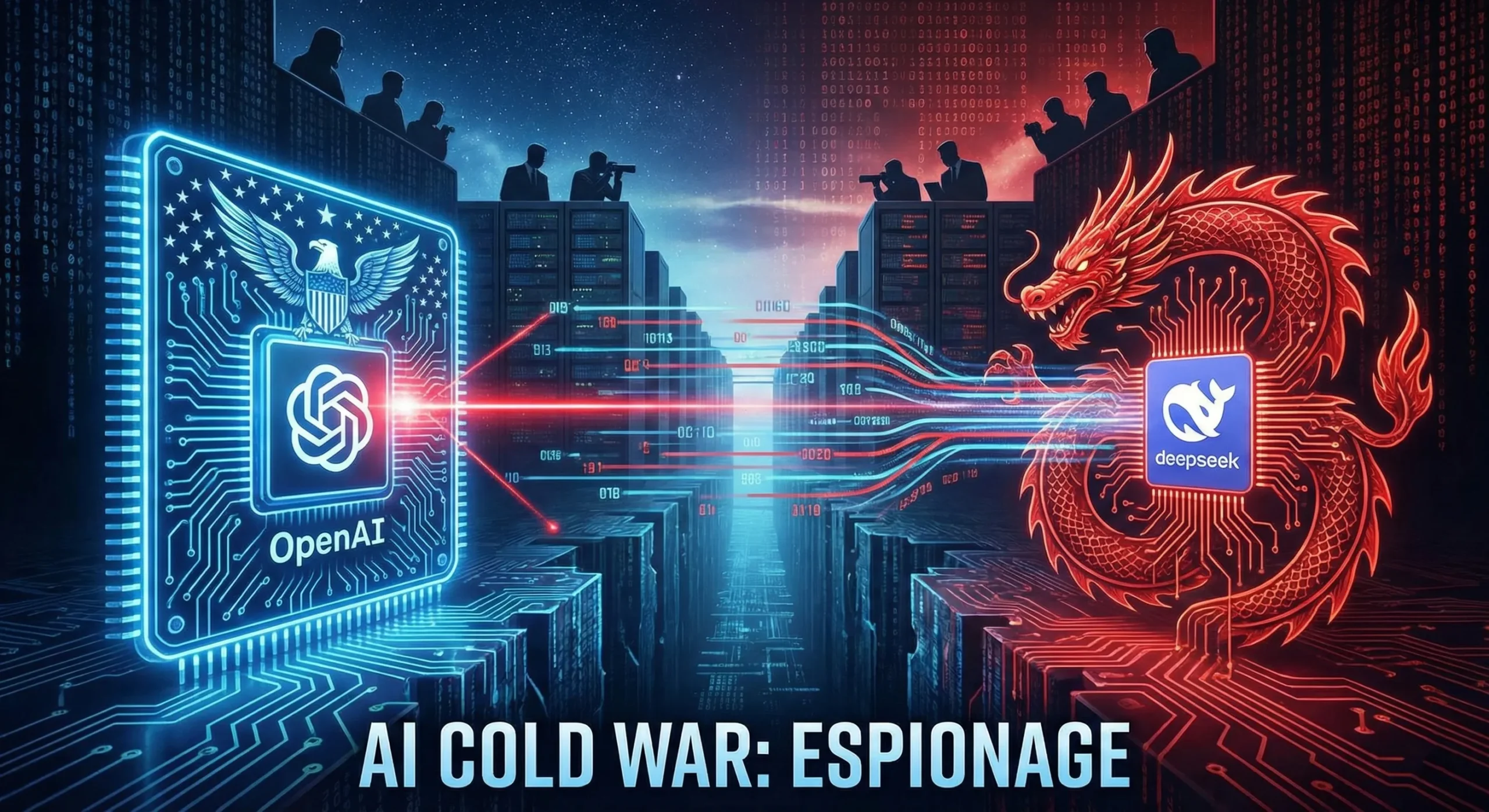
The “AI Cold War” is no longer a metaphor—it is a documented legal and political battle. On Friday, OpenAI escalated its conflict with Chinese rival DeepSeek by submitting a scathing memo to the U.S. House Select Committee on the Strategic Competition Between the United States and the Chinese Communist Party.
The central allegation is damning: DeepSeek isn’t just competing; it is cheating.
The “Distillation” Accusation According to the memo, which was reviewed by multiple sources in Washington, OpenAI claims to have uncovered a massive, sophisticated operation where DeepSeek employees used “obfuscated methods” to harvest data from OpenAI’s most advanced models.
The technique, known in the industry as “Model Distillation,” involves feeding thousands of complex prompts into a superior AI (like GPT-5 or o1) and using the high-quality answers to train a smaller, cheaper model. OpenAI alleges that DeepSeek used a network of masked IP addresses and third-party routers to bypass security protocols, effectively siphoning the “intelligence” of American AI to teach their own systems.
“They are free-riding on billions of dollars of American infrastructure,” the memo reportedly states. “This is not innovation; it is digital espionage masked as open-source development.”
Timing is Everything: The V4 Threat The timing of this accusation is not a coincidence. DeepSeek is rumored to be days away from launching DeepSeek V4 (codenamed “Red Dragon” in some tech circles). Leaks from the Chinese developer community suggest V4 utilizes a massive 1-million token context window and outperforms GPT-5 on complex coding tasks.
If V4 is indeed as powerful as rumored, and if it was built using OpenAI’s own data, it poses an existential threat to the subscription-based business models of Western companies. Why pay $20/month for ChatGPT when a Chinese model—trained on ChatGPT’s own wisdom—is available for a fraction of the cost?
The Security Angle Beyond economics, OpenAI played the national security card. The memo warns Congress that “distilled” models often strip away the safety guardrails embedded in the original US models. This means the knowledge extracted could be used without the ethical filters regarding bioweapons, cyber-attacks, or political disinformation.
DeepSeek’s Silence As of Saturday morning, DeepSeek has not issued an official rebuttal. However, Chinese state media has previously dismissed similar claims as “American anxiety” over losing technological hegemony.
For the tech world, the message is clear: The era of open collaboration is dead. The era of walled gardens and digital trenches has begun.