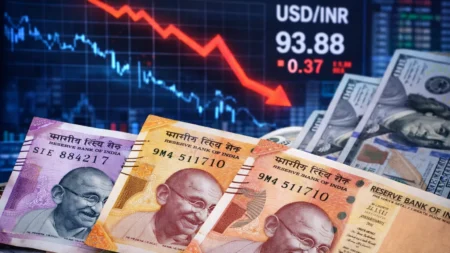
NEW DELHI, March 30: The Indian rupee tumbled to a record low beyond 95 per US dollar on Monday, breaching the psychologically crucial level for the first time as rising crude oil prices, foreign exchange market stress and broader global risk aversion hit sentiment. The currency touched an intraday low of around 95.21–95.22 per dollar, according to multiple reports, marking its sharpest period of weakness in years.
The slide came on a day of deep stress across Indian financial markets. The Sensex and Nifty both fell sharply, oil prices spiked again, and investors remained worried about the impact of Middle East tensions on energy costs, inflation and India’s external position. Brent crude rose above $116 a barrel, adding to pressure on a currency that is especially vulnerable when oil import costs surge.
The rupee’s latest fall is not an isolated move but part of a much bigger deterioration that has built up through March. Reuters reported that the currency was headed for its steepest fiscal-year drop since 2011–12, while the month itself has already turned into one of the most volatile periods for India’s currency market in recent years. Through Friday alone, the rupee had already dropped more than 4% in March, before Monday’s fresh slide pushed it into even more fragile territory.
Why the Rupee Fell So Hard Despite RBI Action
What makes the move more striking is that it came even after the Reserve Bank of India (RBI) tried to stabilise the market. Reuters reported that the RBI recently tightened forex position limits for banks, a move intended to reduce speculative pressure and force some unwinding of aggressive dollar positions. But the relief proved short-lived.
In fact, the RBI’s intervention may have briefly distorted the market rather than fully calming it. According to Reuters, the change in bank positioning triggered a dislocation between India’s onshore dollar-rupee market and the offshore non-deliverable forward (NDF) market. That created an unusual arbitrage opportunity, allowing corporates and market participants to buy dollars cheaper onshore and sell them at higher offshore rates.
That matters because it meant some of the central bank’s stabilising effort was quickly neutralised by market behaviour. Reuters said the size of these built-up positions may have been anywhere between $25 billion and over $50 billion, showing just how large the pressure in the currency system had become. Once those trades started unwinding, volatility increased even further.
The broader macro backdrop also remains hostile for the rupee. India is a major crude importer, so every sustained jump in oil prices worsens the country’s import bill and raises concerns about inflation, current account stress and fiscal pressure. That is why oil shocks tend to hit the rupee much faster than many other market triggers.
Why This Matters Beyond Currency Traders
A weaker rupee does not stay confined to currency markets. If the pressure continues, it can spill into fuel costs, imported inflation, travel expenses, corporate margins and household budgets. That is especially true at a time when oil prices are already surging, because a falling rupee makes every imported barrel more expensive in local currency terms.
For ordinary consumers, the effect may not appear immediately as a “currency crisis” headline. Instead, it can show up more quietly — higher input costs for companies, more pressure on transport and logistics, imported goods becoming more expensive, and inflation risks feeding into everyday expenses over time.
For investors, the signal is equally important. Monday’s move suggests the market is no longer reacting only to short-term headlines, but is beginning to price in a more difficult external environment for India if oil stays elevated and global risk appetite remains weak. Indian equities also reflected that pressure, with benchmark indices posting one of their worst March performances since the Covid-era shock.
The big question now is whether the rupee stabilises with RBI support or whether 95 per dollar becomes the new pressure zone. For now, the message from the market is clear: India’s currency is under its most serious stress in years, and global developments are moving faster than policymakers can comfortably control.