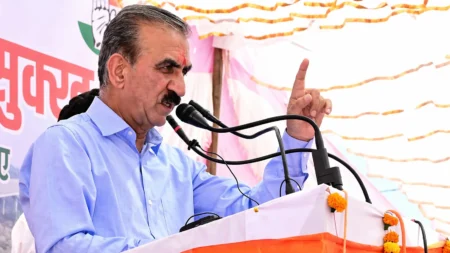
SHIMLA, March 24: The Himachal Pradesh Budget 2026–27, presented by Chief Minister Sukhvinder Singh Sukhu, lays bare a financial reality the state can no longer ignore — rising debt, tight fiscal space and limited room for aggressive spending.
With a total outlay of around ₹54,928 crore, the budget reflects a balancing act between welfare commitments and financial discipline. The numbers themselves tell a story of constraint, where a significant portion of revenue is already tied up in salaries, pensions and debt servicing.
For a hill state with limited revenue sources, that pressure is not new — but it is becoming harder to manage.
The state’s total debt is estimated to be above ₹90,000 crore, a figure that has steadily increased over the years. While borrowing remains a necessary tool for funding development, the growing liability has started to restrict financial flexibility.
Fiscal Deficit Under Watch, But Pressure Remains
The budget estimates a fiscal deficit of around ₹10,000 crore, keeping it broadly within the limits prescribed under the Fiscal Responsibility and Budget Management (FRBM) framework.
On paper, this signals fiscal discipline. In practice, it also means the government has limited headroom to introduce large new schemes or expand spending significantly.
This explains why the budget leans toward continuity rather than expansion across sectors — from welfare schemes to infrastructure projects.
In simple terms, the government is trying to do more with what it already has, rather than stretching finances further.
Revenue Challenges and Limited Options
Unlike larger states, Himachal Pradesh has a relatively narrow revenue base. Tourism, GST collections and excise contribute significantly, but they are often vulnerable to seasonal fluctuations and external factors.
The budget outlines efforts to improve revenue through better tax compliance, policy adjustments and strengthening collection mechanisms. However, there are no immediate breakthroughs expected.
That leaves the government in a familiar position — managing expectations while working within tight financial limits.
Welfare vs Fiscal Discipline: A Tightrope Walk
One of the central challenges reflected in the budget is balancing welfare commitments with fiscal responsibility.
Schemes for women, farmers and vulnerable groups have been continued, but without major expansion. Similarly, infrastructure investments are being pushed, but in a phased manner.
This approach suggests that the government is prioritising stability over aggressive spending — a choice shaped more by necessity than preference.
What This Means Going Forward
The financial signals from this budget are clear.
Large-scale new schemes, immediate relief measures or major hiring drives are unlikely unless the state’s revenue position improves. Instead, the focus will remain on gradual reforms, better implementation and cautious expansion.
For residents, this means expectations may need to be aligned with the state’s financial reality.
Conclusion
The Himachal Budget 2026–27 offers a candid look at the state’s financial condition. Rising debt and controlled deficit levels are shaping policy choices, limiting how much the government can spend while maintaining fiscal discipline.
The challenge ahead is not just managing numbers, but ensuring that limited resources are used effectively — a task that will define the success of this budget.