SHIMLA, March 24: A year after presenting its first full budget, the Himachal Pradesh government has returned with a document that looks familiar on the surface — but operates under far tighter financial constraints.
The Budget for 2026–27, pegged at about ₹54,928 crore, is smaller than last year’s estimated outlay of around ₹58,500 crore. The drop is not just numerical. It reflects a shift in the state’s fiscal position, particularly after changes in central support.
Central Support Changes the Equation
One of the most significant differences between the two budgets is the reduction in revenue deficit support from the Centre, which had earlier helped bridge the gap between the state’s income and expenditure.
While exact annual figures vary depending on projections, officials have indicated that the state is now operating with a noticeably reduced cushion compared to last year. This has had a direct impact on spending flexibility.
In the 2025 budget, there was relatively more room to announce and expand schemes. In 2026, that space appears narrower.
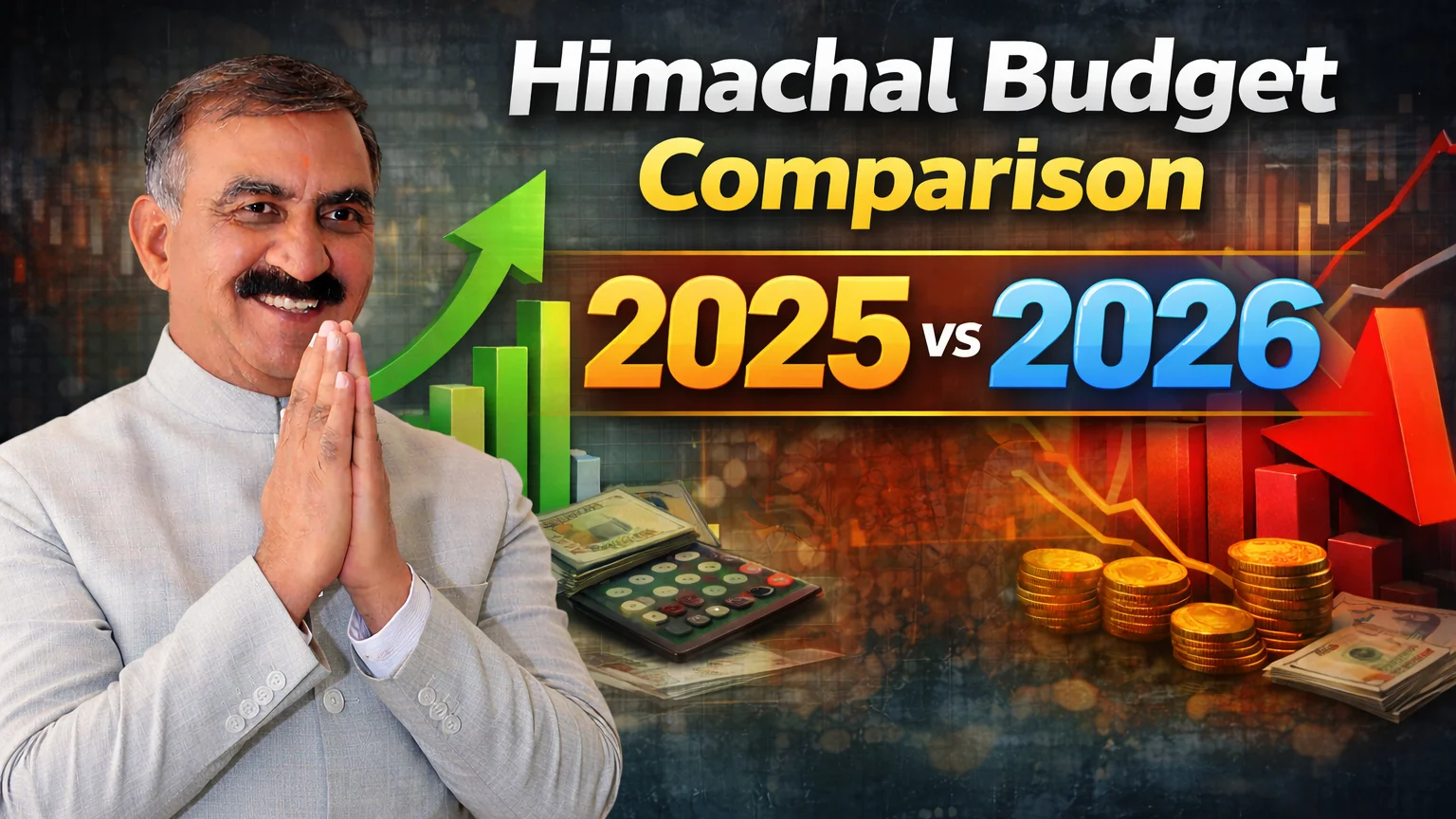
Himachal Budget 2025 vs 2026 — Quick Comparison
| Indicator | Budget 2025–26 | Budget 2026–27 | What It Means |
|---|---|---|---|
| Total Budget Size | ~₹58,500 crore | ~₹54,928 crore | First noticeable contraction, reflects tighter finances |
| Revenue Deficit Support (RDG) | Available (key support) | Reduced / largely absent | Major loss of financial cushion |
| State Debt | Rising trend | ₹90,000 crore+ | Debt becomes central concern |
| Fiscal Deficit | ~₹10,300 crore | ~₹10,000 crore | Similar levels, but higher pressure in 2026 |
| Spending Approach | Expansion + new announcements | Continuity + controlled spending | Shift from growth to stability |
| Welfare Schemes | Expansion phase | Continuation phase | No major new schemes |
| Infrastructure Focus | Strong | Strong | Priority unchanged |
| Tourism Strategy | Growth focus | Expansion to new areas | Direction same, execution cautious |
| Employment Strategy | Expectation of jobs | Focus on self-employment | Realistic shift in approach |
| Financial Flexibility | Relatively higher | Significantly reduced | Core difference between two budgets |
Budget Size and Spending Approach
The decline in total outlay — from roughly ₹58,500 crore to ₹54,928 crore — marks a shift from expansion to consolidation.
The change is visible in how the government has approached spending:
- 2025: More announcements and sectoral expansion
- 2026: Focus on continuing existing schemes
There are no large new flagship programmes this year. Instead, the emphasis is on maintaining ongoing initiatives across sectors.
Debt and Fiscal Pressure
Debt continues to remain a key concern.
State liabilities have been rising steadily, and official estimates place the total outstanding debt above ₹90,000 crore. While this trend was already visible last year, it has become more central to budget planning in 2026.
The fiscal deficit remains broadly within the permissible range under fiscal rules, but maintaining that balance now requires tighter control on expenditure.
This is why the budget appears measured — not because priorities have changed, but because financial space has.
Welfare: Continuity Without Expansion
Across both budgets, welfare remains a constant.
Schemes targeting women, farmers and vulnerable sections have been continued. However, the difference lies in scale.
- 2025: Expansion and new commitments
- 2026: Continuation and consolidation
There is little evidence of major new welfare rollouts this year, suggesting a more cautious approach.
Infrastructure and Tourism: Consistent Priority
If one sector has remained largely unchanged in priority, it is infrastructure — particularly roads and tourism.
Both budgets underline the importance of connectivity and tourism-led growth. The 2026 budget continues this focus, with plans around improving road access and developing new tourism areas.
The difference is again in pace rather than direction.
Employment: Shift in Expectations
Employment remains a concern across both budgets, but the messaging has evolved.
- 2025: Greater expectation of job creation
- 2026: More emphasis on self-employment and gradual opportunities
Large-scale government recruitment does not feature prominently this year, reflecting fiscal limitations.
What Has Stayed the Same
Despite financial pressure, several elements remain consistent:
- Focus on welfare schemes
- Continued investment in infrastructure
- Tourism as a growth sector
- No abrupt policy changes
This continuity suggests that the government is maintaining its broader policy direction.
What Has Changed
At the same time, the differences are clear:
- Reduced budget size
- Tighter fiscal space
- Limited new announcements
- Greater emphasis on financial discipline
These changes point to a government adapting to a more constrained environment.
Conclusion
The comparison between Himachal Budgets 2025 and 2026 is less about contrasting two different visions and more about understanding how the same vision operates under different financial conditions.
Last year’s budget set the direction.
This year’s budget works within the limits.
And for Himachal Pradesh, those limits are now shaping policy as much as priorities.