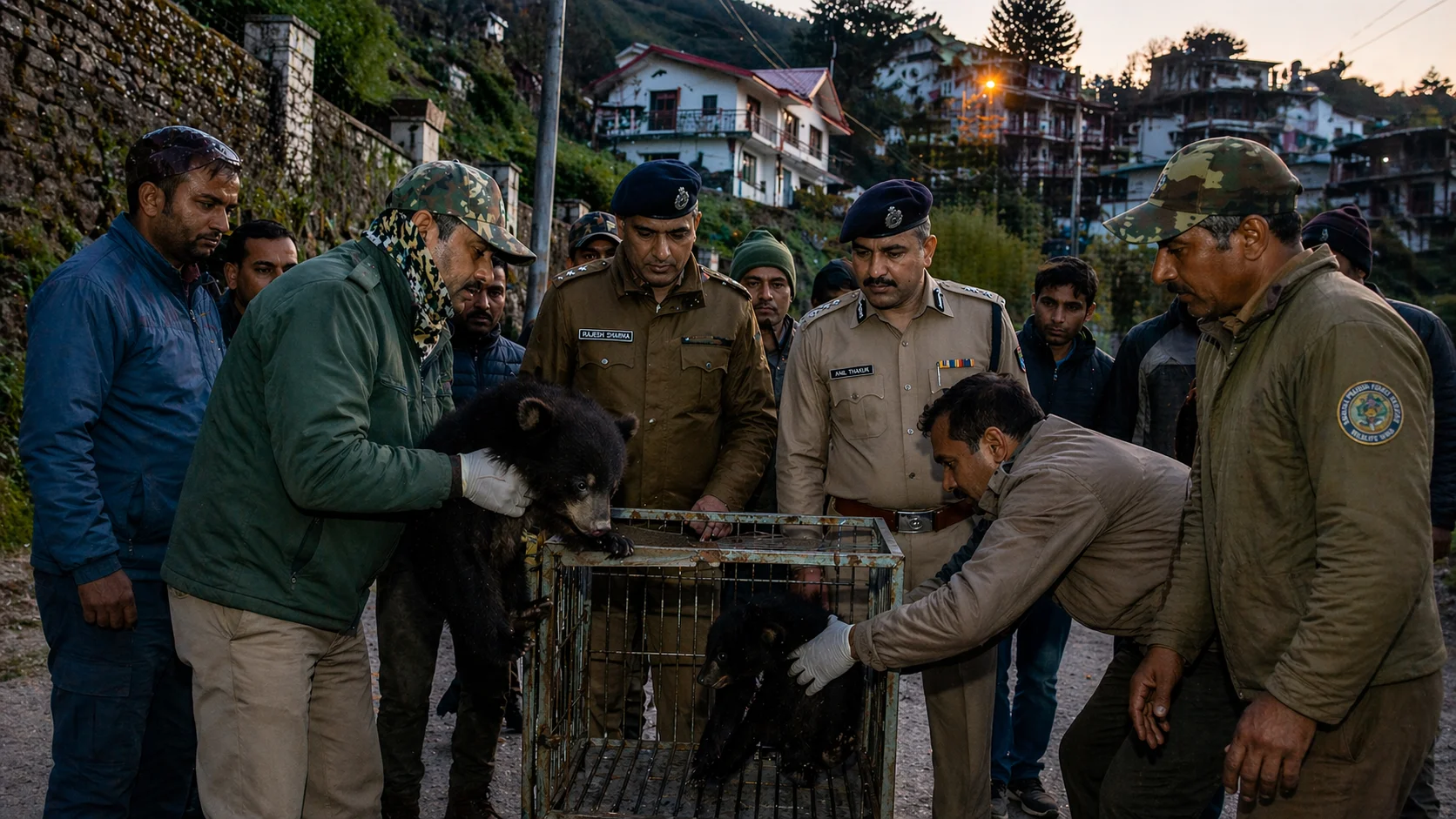
SHIMLA, APRIL 22 — When locals in Theog, a town in Shimla district, reported two Himalayan black bear cubs wandering near homes on Monday night, a tense but swift rescue operation swung into action. The sightings around 7:30 PM on April 21, 2026 near Kufri Heights, a densely populated area, sent authorities scrambling to prevent any harm to the animals or residents. The cubs, visibly disoriented and separated from their mother, had triggered alarm among those who spotted them. According to Mr. Rajesh Sharma, Divisional Forest Officer (DFO) of Shimla, the cubs’ distressed state necessitated immediate intervention.
“The cubs were in a vulnerable state, showing signs of distress,” Sharma said. “We immediately cordoned off the area and deployed a team to safely capture the cubs without causing harm to them or the public.”
The coordinated effort involved personnel from the Shimla Forest Division and the Shimla Police, who tranquilized the cubs before carefully placing them in a cage for transport to the Shimla Zoo for temporary care. No injuries to humans or property were reported during the operation. Inspector Anil Thakur of the Shimla Police emphasized the dual priority of safeguarding residents while prioritizing the animals’ welfare.
“We ensured the safety of residents while prioritizing the welfare of the animals,” Thakur stated.
Officials suspect the cubs may have strayed from their natural habitat due to encroachment or food scarcity. The Himalayan black bear, protected under India’s Wildlife Protection Act, 1972, is typically found in the forested regions of Himachal Pradesh.
Watch Live Himachal News 24×7
Swift Response Averts Potential Danger
Growing Human-Wildlife Conflict in Himachal Pradesh This incident is part of a troubling trend in Himachal Pradesh, where human-wildlife conflicts have surged by 32% over the past five years, according to data from the State Forest Department. The expansion of urban areas into forest fringes, deforestation, and climate change have pushed wildlife closer to human settlements. In 2025 alone, over 140 wildlife rescue operations were conducted in the state, involving leopards, monkeys, and bears.
“As urban areas expand into forest fringes, such incidents are becoming more frequent,” Sharma explained.
Recent cases include a leopard rescued from a home in Kullu last month and a Himalayan monal pheasant rescued from a school in Dharamshala in January 2026. Authorities have ramped up awareness campaigns to educate residents on coexisting with wildlife and reporting sightings promptly.
Long-Term Measures and Public Appeal
The Himala Pradesh Forest Department is stepping up long-term measures to mitigate such conflicts. Plans include installing more warning signage near forest edges, conducting regular patrols to monitor wildlife movement, and establishing a wildlife rescue and rehabilitation center in Shimla district to provide better facilities for injured or orphaned animals.
“We urge residents to avoid approaching wild animals and report sightings to the forest department immediately,” Sharma appealed.
The rescued cubs will undergo a health assessment at the Shimla Zoo before being released into a suitable natural habitat. Officials confirmed that the cubs are in stable condition with no major injuries.
Investigation Continues
While the immediate danger has been averted, the incident has prompted authorities to reassess wildlife management strategies in Shimla district. The State Wildlife Board is set to hold an emergency meeting this week to discuss long-term solutions, including habitat restoration and community awareness programs. For now, the focus remains on ensuring the safe recovery of the cubs and preventing further conflicts between humans and wildlife in the region.